
Water quality has moved from afterthought to priority. Here’s how to navigate the options — from under-sink reverse osmosis to touchless faucets and wall-mounted pot fillers — and choose what actually fits your home.
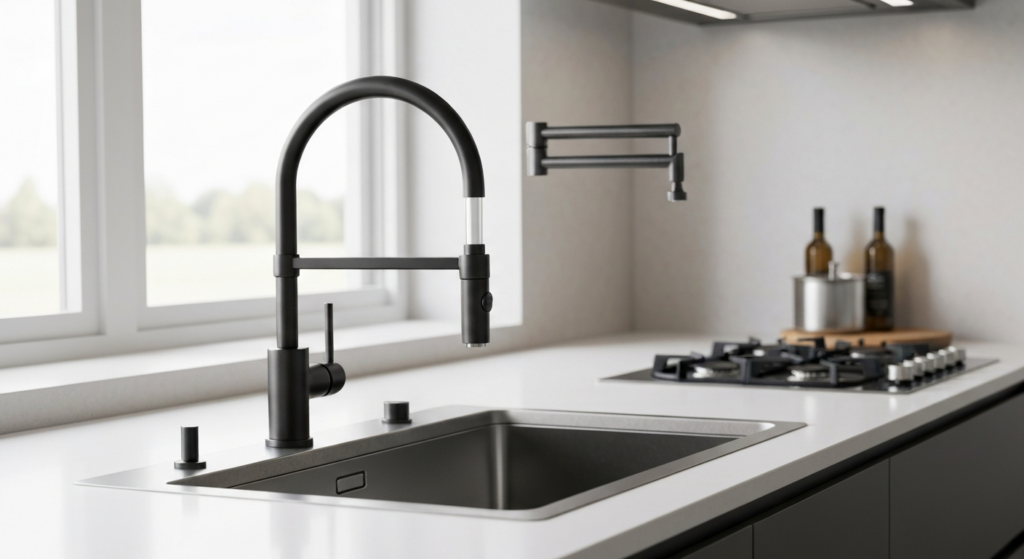
Somewhere between the rise of health-conscious living and growing awareness of what’s actually in municipal tap water, water quality became a mainstream renovation concern. Homeowners who wouldn’t have thought twice about their faucet a decade ago are now researching filtration stages, asking about PFAS removal, and choosing fixtures based on how they interact with water — not just how they look.
The good news: the technology has kept pace with the interest. Filtration systems are more compact and capable than ever. Touchless faucets have shed the clunky sensor aesthetic of early models. And pot fillers — once a niche luxury reserved for professional-grade kitchens — have become one of the most requested kitchen additions. This guide walks through all three categories, so you can make an informed choice rather than an expensive guess.
Water filtration: understanding your options
The home water filtration market is growing fast, driven by rising health consciousness, technological advancements, and consumer demand for convenience. The U.S. home filtration market is projected to grow by 12–15% annually through 2030, driven largely by smart home integration and increasing concern over contaminants like PFAS and heavy metals.
The most important first step is understanding that not all filtration systems do the same job. The right choice depends on your water source, what you want to remove, and how you want the system to integrate with your home.
- Carbon / activated carbon – Removes chlorine, chloramines, bad taste, and odor. Most affordable entry point. Cannot remove dissolved metals, PFAS, or fluoride.
- Reverse osmosis (RO) – Removes 99%+ of contaminants including PFAS, heavy metals, fluoride, and nitrates. Gold standard for drinking water. Produces some wastewater.
- Whole-home systems – Treats all water entering the house — showers, laundry, every tap. Multi-stage carbon media plus optional softening or scale control.
| System Type | Best For | Contaminant removal | Maintenance |
| Pitcher / countertop No installation needed | Renters, light use | Basic | Frequent |
| Under-sink carbon Connected to waterline | Taste & odor | Moderate | Annual |
| Under-sink RO Tankless models save space | Drinking & cooking | Comprehensive | Bi-annual |
| Whole-home system Installed at main line | Every tap, shower, laundry | Broad | Low |
For most homeowners starting out, an under-sink reverse osmosis system at the kitchen tap is the highest-impact move. Interest in under-sink systems has risen sharply — search interest surged from a low base in 2024 to strong sustained demand through 2025 — and the technology has improved considerably. Tankless RO systems now fit in compact under-sink spaces that would have been impossible to fit traditional tank-based units into.
Two trends shaping what homeowners expect from filtration systems right now: smart monitoring — simple flow counters, app reminders, or service alerts that remove the guesswork around filter replacement — and sustainability, with systems that minimize waste and reduce reliance on plastic cartridges aligning with how many families want to run a home today.
“Desire for better health and wellness drives interest in water filtration. Whole-house systems eliminate the need for sink attachments or filtering pitchers — providing safe drinking water directly from the faucet.”
Touchless faucets: convenience that pays off daily
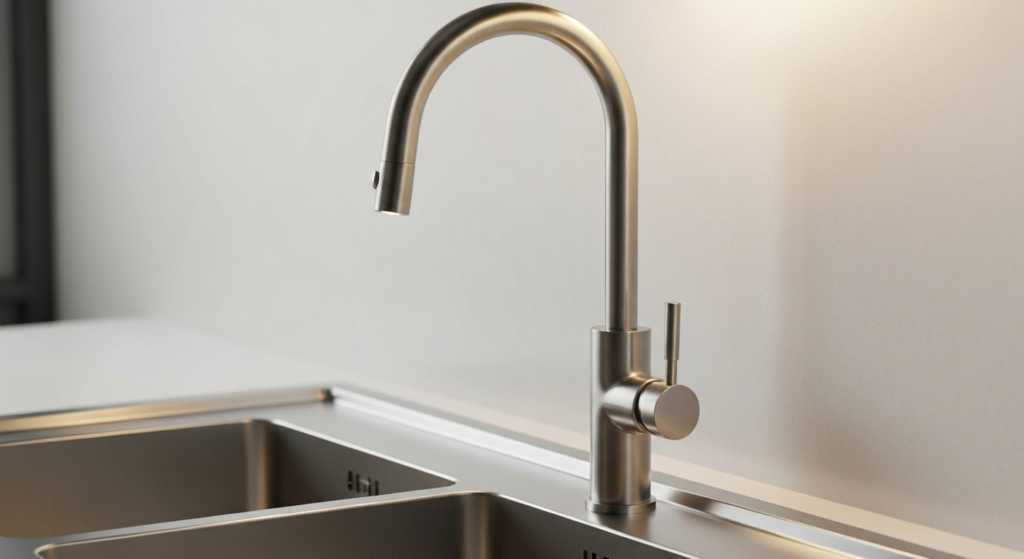
Touchless faucets have been popular in commercial settings for years, and residential adoption has caught up fast. The technology is now built into design-forward fixtures that work with traditional, transitional, and modern kitchen aesthetics — the awkward early-adopter aesthetic is gone.
The core benefit is straightforward: you can turn water on and off without contact when your hands are full of raw chicken, coated in dough, or holding a pot. Motion-sensor activation — typically a wave of the hand in front of a sensor — handles the most common use case cleanly. Higher-end smart faucets extend this with Wi-Fi connectivity, voice assistant integration, and mobile app control. Voice control on platforms like Amazon Alexa or Google Assistant means you can say “dispense two cups of water at 70 degrees” and the faucet fills precisely to that specification — a genuine convenience for measured cooking.
- Motion-sensor (touchless) – Wave to activate. Prevents cross-contamination, reduces water waste. Battery or hardwired. Most accessible price point.
- Voice-activated smart – Wi-Fi connected, Alexa/Google compatible. Precise volume and temperature dispensing. Requires hub or AC outlet under sink.
- Touch-activated – Tap anywhere on the spout or handle to start/stop. More intuitive than motion sensors for some users. No hands-free benefit.
What to check before buying a touchless faucet
- Power source: battery-powered units need access for replacement; AC-powered units need an outlet under the sink
- Sensor placement: side sensors reduce accidental activation versus front-only sensors
- Flow rate: WaterSense certified models flow at 1.5 GPM or less — check if that’s sufficient for your household’s use
- Spray modes: confirm pull-down or pull-out sprayer range suits your sink size
- Finish matching: if coordinating with a pot filler or other fixtures, order samples — finish names vary widely between brands
- Smart features: voice and app control require Wi-Fi and a compatible hub; confirm compatibility with your existing smart home setup
Pot fillers: practical luxury above the range
Pot fillers are wall-mounted faucets installed above the range or cooktop, connected to a dedicated cold-water supply line. They eliminate carrying heavy pots of water from the sink to the stove — both a genuine convenience and a back-strain reduction for anyone who cooks regularly with large stockpots, pasta pots, or canning equipment.
Once a symbol of the professional kitchen or high-end remodel, pot fillers are now one of the most requested kitchen additions across a much wider range of budgets. They serve as a design statement — drawing the eye upward to the hood or backsplash wall — while solving a real daily problem for anyone who cooks.
The fixture itself typically has two joints that allow it to fold flat against the wall when not in use. A double-shutoff valve — one at the wall and one at the head — is standard for safety. Finishes follow the same trajectory as the broader kitchen hardware market: matte black, brushed brass, champagne bronze, and brushed nickel are the dominant choices, with warm metallics leading the current cycle.
Before installing a pot filler — key planning questions
- Is there a cold-water supply line accessible behind the wall above your range? This is the most critical factor — retrofitting one can add cost
- What height? The standard installation is 20–24 inches above the cooking surface — measure your tallest pot plus clearance
- Tile or no tile? Wall finishing around the mount point should be completed before installation, not after
- Single or double-joint arm? Double-joint arms extend further and are more useful for wide ranges or off-center burners
- Finish coordination: pot fillers are a long-term fixture — choose a finish that matches or complements your main faucet and hardware throughout the kitchen
- Budget: fixture cost runs $150–$500 depending on finish; installed cost including rough-in is typically $300–$800
How these upgrades work together
The most effective kitchen water setups pair a whole-home or under-sink filtration system with a dedicated filtered-water tap at the sink — keeping clean drinking water separate from the main faucet. Add a touchless main faucet for hands-free convenience during cooking prep, and a pot filler above the range for the moments that require moving the most water. Each solves a different friction point; together, they make a kitchen that works significantly better than one that hasn’t thought through its water use at all.
The fixtures you choose here are among the most used in your home — your kitchen faucet alone may be operated dozens of times a day. Choosing quality, finish-matched hardware that’s backed by reliable warranties and replacement parts is a longer-term investment than it might initially appear.